
Renaissance in Florence
Understanding the art for beginners
Who were Brunelleschi, Donatello, Botticelli and Michelangelo, what made their work new, and where in Florence can you see it today? A beginner's guide.
Contents
Florence is often called the cradle of the Renaissance, and that's not just a tourist-brochure line
- it can be traced through specific works and dates. Within a few decades, Florentine masters solved problems that European art then followed for centuries. Knowing who created what, and when, turns a museum visit from a flood of images into a story you can actually follow. This guide sorts out the key figures, their major works, and where to find them today.
Why the Renaissance began here of all places
Money and one family laid the groundwork. The Medici ruled Florence from 1434, when Cosimo de' Medici the Elder (1389-1464) came to power; this first line governed until 1537. Cosimo was the great patron of the early generation, backing Ghiberti, Brunelleschi, Donatello and Fra Angelico among others. His grandson Lorenzo the Magnificent (1449-1492, ruled from 1469) is seen as the high point of Medici art patronage, the young Michelangelo trained within his circle.
Wealth from trade and banking financed not just churches but a new way of thinking. Artists and scholars looked back to antiquity and put the human figure at the centre of their work. One thing worth knowing before you visit: sacred art, altarpieces and church frescoes, still made up the bulk of output. Mythological, secular works like Botticelli's Venus were the exception, usually created for the Medici's private circle, which is why you'll mostly find religious subjects in the city's churches, while the pagan icons hang in the Uffizi.
The key figures, in the right order
The Renaissance wasn't a single style that appeared overnight but a sequence of generations. Four uncontested core figures are enough to understand how it developed:
- Filippo Brunelleschi (1377-1446) belongs to the early generation. He's considered the founder of Renaissance architecture, his dome for the Cathedral was the era's great feat of engineering - and a pioneer of mathematical perspective.
- Donatello (c. 1386-1466) was Brunelleschi's contemporary and the defining sculptor of the early Renaissance. His bronze David redefined what a sculpture could be.
- Sandro Botticelli (1445-1510) represents the late Quattrocento generation, the closing decades of the 15th century, with its linear, poetic imagery.
- Leonardo da Vinci (1452-1519) and Michelangelo Buonarroti (1475-1564) carried the High Renaissance to its peak around and after 1500.
Following this order on a visit - Brunelleschi and Donatello first, then Botticelli, then Leonardo and Michelangelo, makes it easier to see figures become more lifelike, spaces deeper, and compositions more confident.
The invention that changed everything: perspective
The single most consequential innovation was linear perspective, a mathematically correct way of rendering spatial depth on a flat surface. The concept is credited to Brunelleschi, but a painter was the first to put it fully into practice.
Masaccio's fresco of the Holy Trinity in the church of Santa Maria Novella was painted around 1427-1428 and is considered the first painting to apply single-point perspective consistently to represent three-dimensional space. Viewed from the right spot, the painted barrel-vaulted architecture looks like a real recess cut into the wall, an early trompe-l'œil effect. What makes it more remarkable is the artist's age: Masaccio (1401-1428) died at around 26, yet ranks among the decisive pioneers of Renaissance painting. Seeing the fresco before a museum visit makes it much easier to know what to look for at the Uffizi.
Sculpture at the Bargello: Donatello's David
The best place to grasp the break with the medieval past is sculpture. Donatello's bronze David is considered the first freestanding, independently cast nude statue since antiquity, a naked figure standing alone in space, something unseen for over a thousand years. Its exact date is uncertain because the casting wasn't documented; most scholars place it in the 1440s. It was commissioned by Cosimo de' Medici and originally stood in the courtyard of the Medici Palace.
Since 1865 the work has been on display at the Bargello Museum (Museo Nazionale del Bargello), Florence's principal sculpture museum. More on the building and its collection at Bargello Museum. It's a compact visit, around an hour to an hour and a half covers it. Admission prices and closing days change, so check ahead; the museum is closed on some days of the week.
Painting at the Uffizi: Botticelli, Leonardo, Michelangelo
The Uffizi Gallery is the headquarters of Renaissance painting. The two most famous works are both by Botticelli: the Primavera (usually dated around 1480-1482) and the Birth of Venus (dated by the Uffizi to around 1485). Both hang here, and both are mythological scenes with no Christian subject, exactly the exception mentioned above. Who commissioned them isn't firmly documented, but they most likely came from the Medici circle; the Primavera is usually attributed to Lorenzo di Pierfrancesco de' Medici, a cousin of the ruling branch.
Beyond those two, a handful of High Renaissance works are worth seeking out deliberately. Among the most cited highlights are Leonardo's Annunciation, Michelangelo's Doni Tondo, and Raphael's Madonna of the Goldfinch. If you want to trace the development, you can follow the arc from Botticelli's linear style to Leonardo's softer transitions and Michelangelo's sculptural figures all within the same building.
Practical planning notes:
- Opening hours. Tuesday to Sunday, 8:15-18:30, last admission 17:30. Closed Mondays, and on 1 January and 25 December.
- 2026 prices. Standard ticket €25 on site, €29 online (plus a €4 booking fee). Since 1 January 2026 there has been an afternoon discount from 16:00 - €16 on site, €20 online.
- Duration. Allow at least two hours for the main works, three to four for a relaxed visit.
- Combined ticket. The combined ticket for the Uffizi plus Palazzo Pitti plus Boboli Gardens is valid for five days with one entry per site (priced around €40). Worth it if you're planning to see the Pitti collections anyway.
Michelangelo's David and a route that makes sense
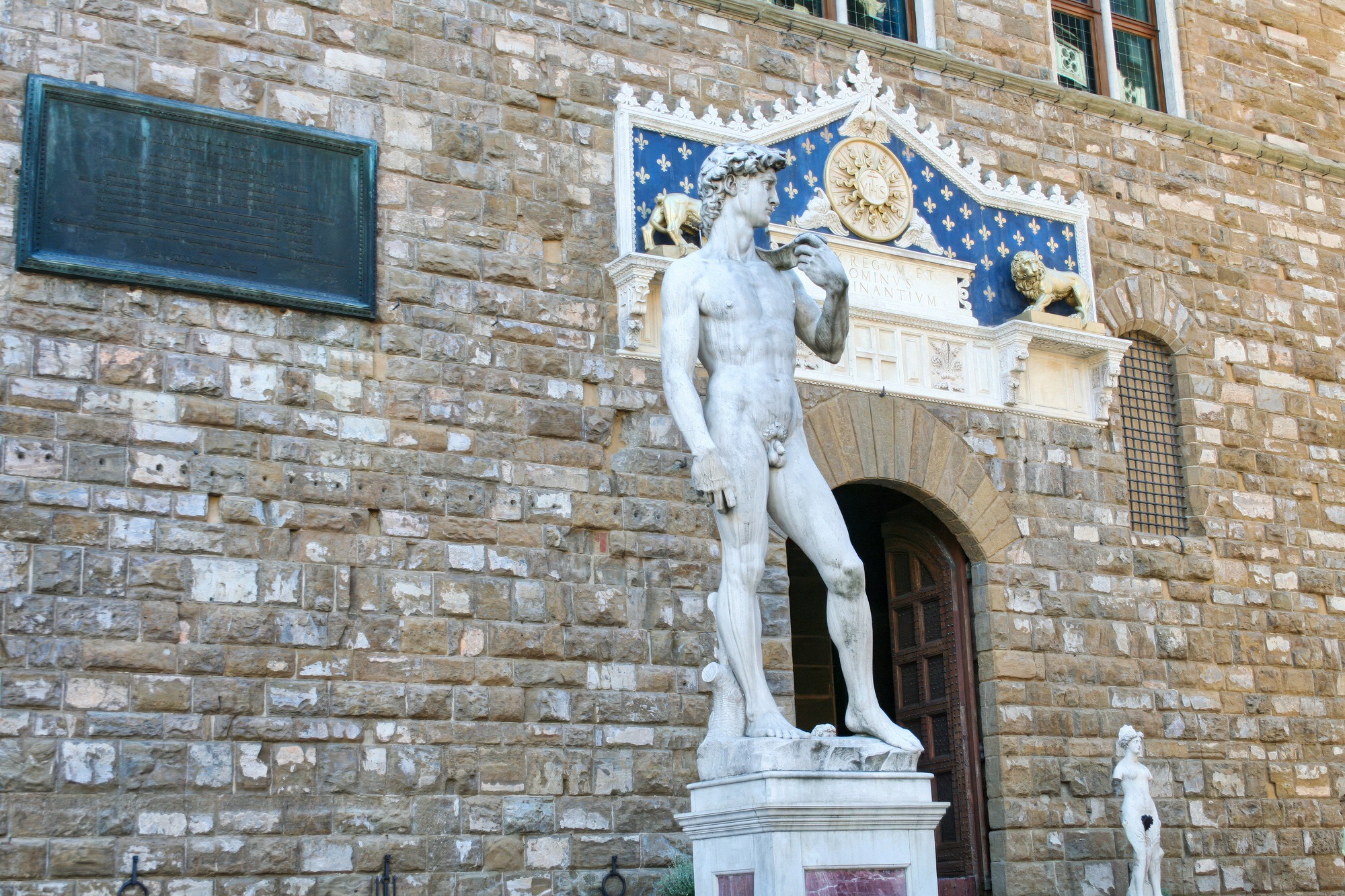
The city's most famous single work is arguably Michelangelo's marble David, carved 1501-1504. It was originally planned for a buttress on the Cathedral; in 1504 it was instead installed in front of the Palazzo della Signoria, today's Palazzo Vecchio. This is exactly where confusion tends to arise: the statue on Piazza della Signoria today is only a copy, standing at the historic spot. The original moved to the Accademia Gallery in the 19th century and can only be seen there.
For a route that makes sense of the period rather than just ticking off sights, a simple order works well:
- Sculpture first, then painting. See the early Renaissance through Donatello at the Bargello, then painting at the Uffizi, roughly following the chronological development.
- Look properly at a few works. Spending real time with two or three paintings, noticing perspective, light, and increasingly lifelike figures, gives you more than rushing through every room.
- A little reading pays off. Giorgio Vasari's "Lives of the Artists" (1550, generally considered the first work of art history) and Ross King's "Brunelleschi's Dome" make good, readable preparation. On site, the official museum apps and audio guides cover the highlights.