Food & Drink in Florence
Bistecca, lampredotto & wine
Bistecca alla Fiorentina, lampredotto from a stall, ribollita, proper gelato and Chianti, what Tuscan cooking in Florence really tastes like, and where to eat it.
Contents
Florentine cooking is part of the wider Tuscan tradition: hearty, meat-heavy and built on a handful of good ingredients, bread, olive oil, beans, beef. Eating well here doesn't require expensive restaurants; the best dishes come from the leftovers kitchen and the market. This guide sorts out what to try, how to spot quality, and where to go for it.
The Bistecca alla Fiorentina, the city's signature cut
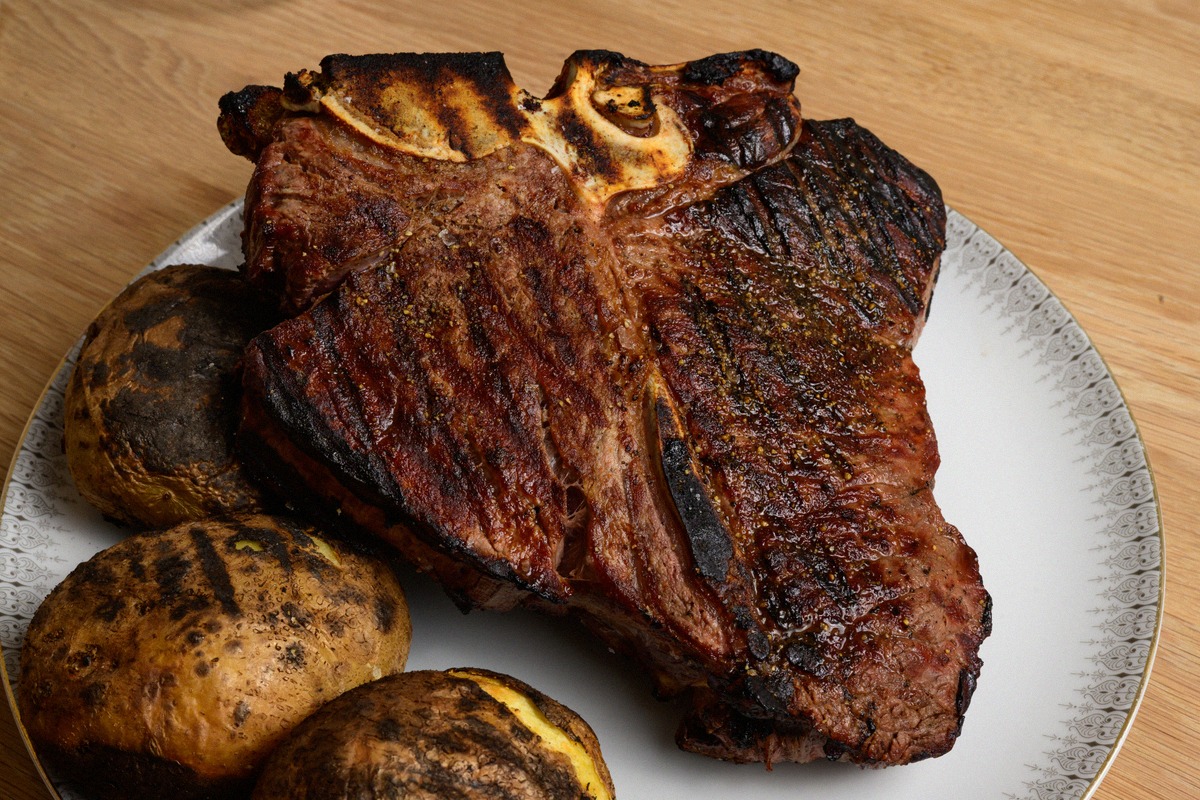
The city's most famous dish is the Bistecca alla Fiorentina, a T-bone steak roughly three fingers thick (about 5 cm), grilled briefly over embers and served rare inside. A traditional cut weighs 800 grams to 1.2 kilos and isn't meant as a single portion, it's shared between two or three people. It's priced by weight, per kilo or per 100 grams (al etto), running roughly 40 to 65 euros per kilo in 2026.
The meat matters most. For a bistecca considered regionally authentic (PAT), the beef should come from a Tuscan breed - Chianina, Calvana or Maremmana, or at least be born and raised in Tuscany. The historic favourite is the pale Chianina from the Val di Chiana, roughly an hour's drive southeast of Florence and one of the largest cattle breeds in the world. Certified Chianina beef sits at the top end of the price range or above it.
- Don't order it well done. Bistecca is traditionally served rare (al sangue). You can ask for it more done, but it rather misses the point of the dish.
- Order it to share. The custom is to order one large cut for the table and agree the weight with the waiter beforehand, rather than a steak per person.
- Sides stay simple. Expect white beans (fagioli all'olio), roast potatoes or a plain salad - nothing elaborate.
Offal, soups and the seasonal leftovers kitchen
Beyond the steak, Tuscan cooking is above all a cuisine of leftovers and the seasons. The best-known street food is lampredotto, the cow's fourth stomach, slow-cooked in a spiced broth and served in a panino, with the top of the roll often dipped briefly in the broth. Closely related is trippa alla fiorentina, tripe braised with tomato. Both are traditionally eaten standing at a stall (see below), though they increasingly appear on trattoria menus too.
Bread dishes that use up stale loaves are strongly seasonal:
- In winter, warming bread soups: ribollita with cavolo nero (black kale), beans and bread, and pappa al pomodoro, a thick bread-and-tomato soup.
- In summer, cold versions: panzanella, a salad of soaked bread, tomatoes and basil, and insalata di farro, a spelt grain salad.
- All year round, peposo, a slow-braised, heavily peppered beef stew.
A word of honest expectation-setting: Florence is inland, so fish is uncommon and untypical here. Fresh seafood belongs more to the Tyrrhenian coast, anyone hunting for fish specialities in Florence is usually looking in the wrong place.
Mercato Centrale and the lampredotto stall
The best starting point for Florentine food is Mercato Centrale in San Lorenzo. The building has two very different floors: the ground floor is a traditional food market with butchers, cheese and vegetable stalls, open Monday to Saturday roughly 7:00-14:00, closed on Sundays. The first floor is a modern food hall with stalls covering many cuisines, open daily from around 10:00 to midnight, about as different a rhythm as you can get in one building.
The address for offal classics is Da Nerbone on the ground floor, a lampredotto and trippa stall that has stood on the same spot since 1872. A lampredotto panino costs around 5 euros here, a bowl of trippa alla fiorentina about 8 euros. The stall is typically open Monday to Saturday from around 9:00 to 14:00; expect a queue around the lunchtime rush, roughly 12:30-14:00. More on the market itself is on the Mercato Centrale page.
Where to eat properly Tuscan, trattorias in the Oltrarno
For authentic food without a tourist markup, head away from the main sights, especially the Oltrarno on the south bank of the Arno and around Piazza di Santo Spirito. A short, clearly labelled selection, opening hours change, so it's worth checking or booking ahead:
- Trattoria Cammillo (Borgo San Jacopo 57/r), a Tuscan trattoria running since 1945, at the higher end of the price range, usually busy in the evening; booking recommended.
- Osteria Santo Spirito (Piazza di Santo Spirito 16), popular with locals, fresh pasta and regional produce, mid-range prices; booking advisable.
- Trattoria Sabatino (Via Pisana, San Frediano), run by the Buccini family since 1956, deliberately simple and affordable, an institution for honest home cooking.
- Osteria Tripperia Il Magazzino (Piazza della Passera), serves lampredotto and other offal dishes trattoria-style, not just from a stall.
If you'd rather have a glass of wine with a small sandwich close to the centre, look for Florence's vinaino and fiaschetteria tradition, small, often historic wine bars. Examples include Vinaino Fiorenza (Via Vacchereccia 13R) near Piazza della Signoria and the historic Fiaschetteria Nuvoli (Piazza dell'Olio 15) close to the Duomo.
Chianti, Vin Santo and choosing the right wine
Florence sits right in the middle of the Chianti wine region, and the wine you'll drink with your meal here is almost always a Sangiovese red, though the labels can be confusing. Chianti DOCG comes from six Tuscan provinces (Florence, Siena, Arezzo, Pisa, Pistoia, Prato). Chianti Classico DOCG, by contrast, comes only from the historic core zone between Florence and Siena, carries the Gallo Nero (black rooster) seal, and requires a higher minimum share of Sangiovese (at least 80 rather than 70 percent), generally the denser, higher-quality wine of the two.
- A glass of house wine or Chianti typically costs 5 to 8 euros at a wine bar in 2026.
- A Chianti Classico or a better producer runs more like 9 to 15 euros and up per glass.
To finish, there's Vin Santo, a traditional sweet straw wine ("holy wine") produced mostly in Tuscany. Vin Santo del Chianti DOC covers the whole Chianti zone and accounts for most of the Vin Santo traded internationally. It's served with cantucci (also called cantuccini or biscotti di Prato), dry almond biscuits from Prato near Florence, dipped one at a time into the Vin Santo. The protected "Cantuccini Toscani IGP" variety must contain at least 20 percent whole almonds.
Bread, schiacciata and proper gelato
Tuscan bread is traditionally unsalted (pane sciocco), bland on its own at first, but a good match for salty cured meats and rich sauces. The essential snack format is schiacciata, a flat, crisp flatbread. It's thinner and chewier than the taller, airier Ligurian focaccia, uses a lower hydration dough and is flattened before baking, traditionally topped with nothing more than sea salt and olive oil. This schiacciata is the base for Florence's famous panini (as served, for example, at All'Antico Vinaio).
With gelato, the gap between craft and tourist trap is wide. Reliable, gelato-focused addresses include Gelateria de' Neri (Via dei Neri), Vivoli (the oldest gelateria, open since 1930), Perché No! (since 1939) and Gelateria della Passera in the Oltrarno. A scoop of the real thing costs about 2.50 to 5 euros. What to look for:
- Covered metal tubs (pozzetti) rather than piled-up, neon-bright mountains.
- Muted, natural colours, pistachio should be dull green, not toxic green.
- A limited range of flavours, around twelve to twenty rather than forty or more.
- Fast melting, and a shop that specialises in gelato rather than selling everything else too.
Tall, shape-holding, brightly coloured scoops point to stabilisers, common in the areas right around the Duomo and Ponte Vecchio.
What it costs, a price guide
Florence isn't cheap, but you can eat well at every price point. A few rough benchmarks for 2026 - standing at the bar is always cheaper than sitting down with table service:
- Espresso around 1.10 euros, cappuccino about 1.60 euros at the bar.
- Beer (0.5 litre) roughly 4.50 to 5.50 euros depending on the venue.
- A simple main course at a trattoria around 13.50 to 16.50 euros.
- Street food such as a lampredotto panino from about 5 euros, a scoop of gelato 2.50 to 5 euros.
As a rough daily budget for food and activities, a modest travel budget starts at around 88 euros per person; it's open-ended above that, for example with several restaurant meals featuring good bistecca and wine. Anyone wanting a day out in the countryside, into Chianti or to the wine estates, will find ideas in the guide Day trips from Florence.